
Skip to content
janitorial workplace services

The Signal Problem: Why Leadership Hiring Fails Before the Interview Begins (intro)

EG Talent Strategist
The Signal Problem: Why Leadership Hiring Fails Before the Interview Begins (intro)
12:58


At the executive level, nearly every candidate looks qualified. Resumes are strong. Experience is relevant. Track records are compelling. But those signals are often misleading.  Because leadership success is not defined by what someone has done. It is defined by whether they can deliver in a specific environment.

This is what we refer to as the signal problem.

The Signal Problem

Access to executive talent has never been easier. With platforms like LinkedIn, expanded networks, and AI-powered sourcing tools, organizations can identify candidates faster than ever before. What once required deep networks and retained search can now be initiated with a few searches and messages.

But access is no longer the advantage. Evaluation is. As Erika Scanlin, President of EG, explains:

“Access used to be the advantage. Now it’s the baseline. The real challenge is knowing who will actually work in your environment.”

At the executive level, the challenge is not finding candidates. It is determining which leader will actually succeed.

CASE

Defining Signal: The CASE for Success

Signal is not experience alone. It is the combination of factors that determine whether a leader will succeed in a specific environment.

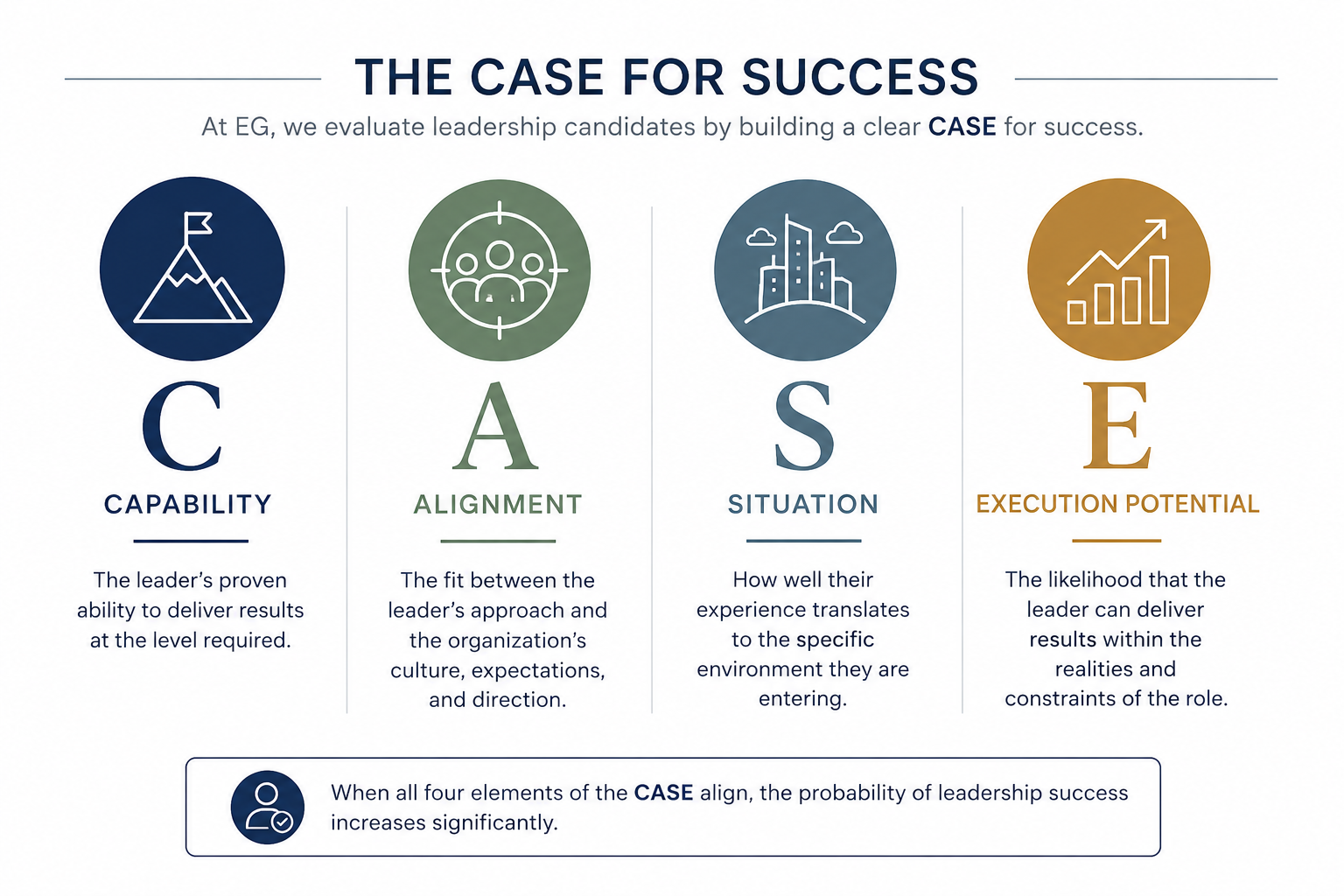
At EG, we evaluate leadership candidates by building a clear CASE for success:

  • Capability – the leader’s proven ability to deliver results at the level required 

  • Alignment – the fit between the leader’s approach and the organization’s culture, expectations, and direction 

  • Situation – how well their experience translates to the specific environment they are entering 

  • Execution Potential – the likelihood that the leader can deliver results within the realities and constraints of the role 

When one of these elements is misunderstood or missing, risk increases. When all four align, the probability of success improves significantly.

Most hiring processes, however, over-index on visible signals—titles, tenure, personality and company names—while underweighting context, alignment, and execution. As a result, organizations make decisions based on incomplete information.

And those decisions often fail—not because the candidate lacked talent, but because the full CASE for success was never properly evaluated.

 

Share this post