janitorial
workplace services


For the past several years, one idea has dominated hiring conversations:
There aren’t enough candidates.
Across manufacturing, logistics, and skilled trades, leaders point to labor shortages as the reason roles remain open. Job postings sit unfilled. Pipelines stall. Hiring timelines stretch.
On the surface, the explanation feels obvious. The labor market is tight. Workers are scarce. Hiring is harder.
But that explanation does not fully hold up. Because if there truly weren’t enough candidates, your competitors wouldn’t be hiring in the same markets, for the same roles. Positions wouldn’t eventually get filled. Movement wouldn’t continue.
And yet—it does. The problem isn’t that candidates don’t exist. It’s that most organizations cannot consistently reach them.


There is no question that hiring has become more complex. Organizations are navigating:
Lower response rates to job postings
Increased competition for hourly and skilled workers
Changing expectations around pay, flexibility, and work environment
A growing reliance on digital platforms to attract candidates
In many cases, roles receive few qualified applicants—or none at all. So the conclusion feels logical:
There simply aren’t enough people. But that assumption leads to the wrong solution. Because it frames hiring as a supply problem—when in reality, it is a distribution problem.
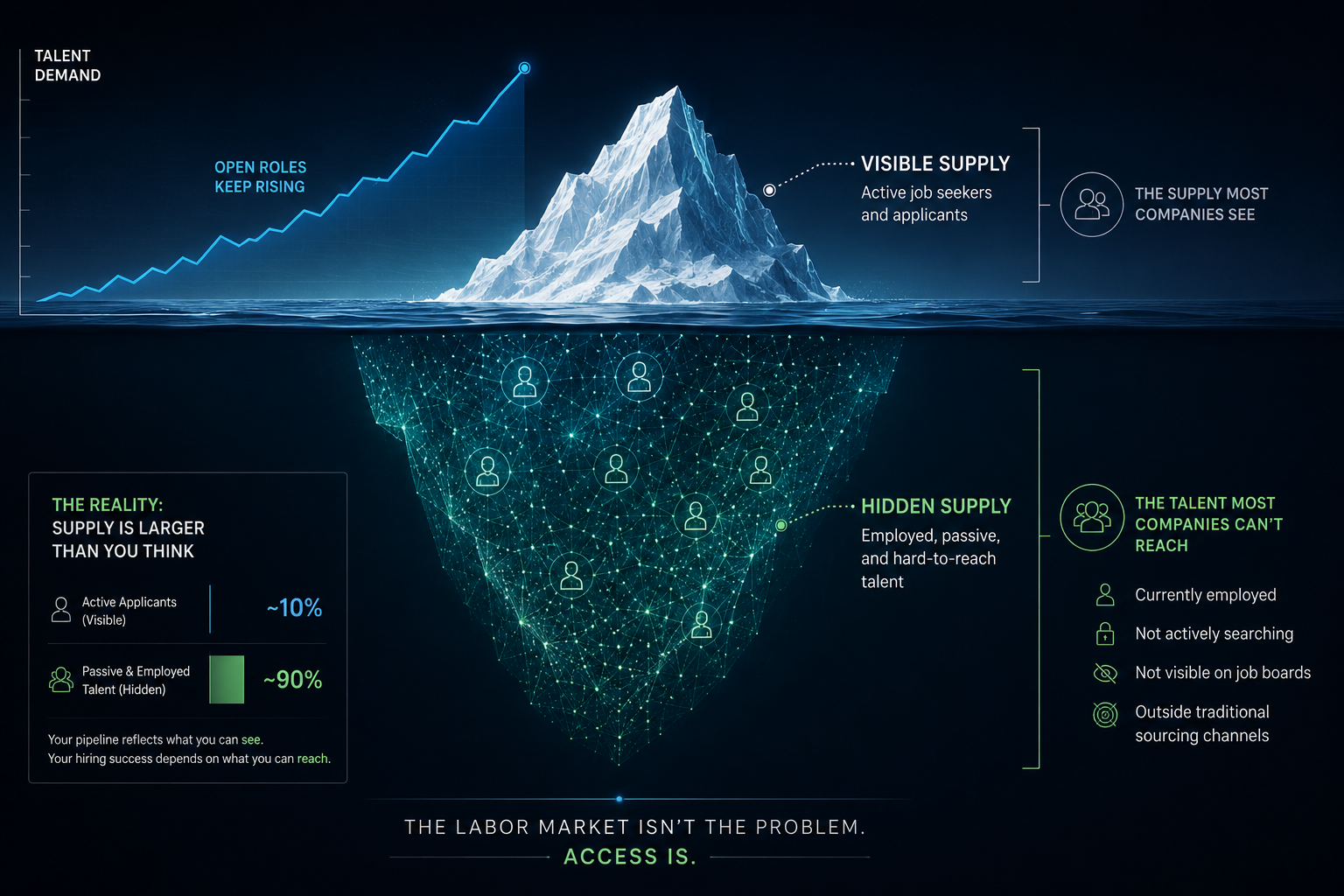
If the issue were purely supply, hiring would stall indefinitely. But that is not what happens.
Positions eventually get filled. Workers move between companies. Some organizations consistently generate candidates—while others struggle to build even a basic pipeline.
The difference is not talent. It is access.
As Erika Scanlin, President of EG, explains: “The candidates aren’t gone. They’re just not applying in traditional ways. And if your strategy depends on a ‘post and pray’ approach, your pipeline will always be unpredictable.”

That is the disconnect. Most hiring systems were built for a market where candidates actively searched and applied. That is no longer the reality.
The majority of viable candidates today—especially in hourly, manufacturing, and skilled roles—are not actively applying to jobs.
They are:
Currently employed
Passively open, but not searching
Unaware of your opportunity
Not engaging with traditional job channels
At the same time, job boards have become saturated. Posting a role does not guarantee visibility. Visibility does not guarantee engagement. And engagement does not guarantee alignment.
The result is a hiring model that is fundamentally reactive:
Post the job
Wait for applicants
In today’s market, that approach produces inconsistent—and often insufficient—results.

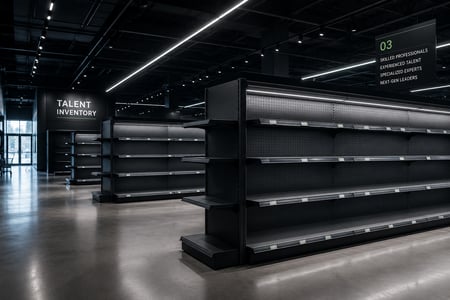 Imagine a retailer attempting to run a store by waiting for inventory to arrive on its own.
The doors are open. The lights are on. The signage is in place. And yet, the shelves remain empty.
No retailer would operate this way. They actively manage supply. They source inventory. They build supplier relationships. They ensure the right products are available when customers need them.
Hiring, however, is still often approached this way.
As Erika puts it: “You can’t run a business without controlling your supply chain. Hiring is no different. If you’re waiting for candidates to come to you, you’re not managing supply—you’re reacting to it.”
This is the shift:
From passive intake To active supply management
Most organizations have not fundamentally changed how they approach hiring. They have added tools. Increased job postings. Expanded spend. But the underlying model remains the same—and it is starting to break.
Three issues are driving that breakdown:
Over-reliance on inbound channels: Job boards and applications remain the primary source of candidates, despite declining effectiveness.
Tool fragmentation and overload: Teams are navigating multiple platforms, subscriptions, and sourcing tools—each requiring time, expertise, and management.
Limited internal bandwidth: Talent teams are expected to source, screen, coordinate, and hire—often without the capacity to do all of it well.
As Erika explains: “There are more tools than ever, but no one has time to figure out which ones actually work. Most teams are trying to build a sourcing engine while also trying to hire—and that’s where things break.”
The outcome is predictable:
More activity.
More complexity.
But not more candidates.
Recognizing the limitations of inbound hiring, many organizations attempt to solve the problem by adding technology.
LinkedIn licenses. Job board upgrades. AI sourcing platforms. Resume databases.
Each promises access.
But access is not created by a subscription. It requires:
Time to learn and manage platforms
Expertise to use them effectively
Consistent execution across roles and locations
Continuous optimization as tools and algorithms evolve
For most internal teams, this creates a new problem, complexity without consistency.
At some point, the priority must shift from accumulating tools to ensuring reliable, scalable access to talent.
 High-performing organizations are making a fundamental shift in how hiring works.
From:
Job posting
Reactive pipelines
Inbound dependency
To:
Active sourcing
Direct candidate engagement
Continuous pipeline generation
This shift reflects a simple reality, candidates do not need to find you. You need to find them.
Solving the access problem does not require building a complex internal sourcing engine. For many organizations, that approach is neither practical nor scalable. Instead, a new model is emerging:
On-demand access to talent.
This model is built on a different premise:
You do not need to own the tools.
You do not need to manage the platforms.
You do not need to build the infrastructure.
You need access to it—when and where you need it.
This includes:
Multi-channel sourcing across platforms and networks
Technology-enabled candidate identification
Scalable support aligned to hiring demand
Accountability through data and process visibility
When implemented effectively, this model delivers what most organizations lack: consistency.
What this changes is not just how candidates are found—but how quickly hiring momentum can be created. Instead of waiting weeks to see if a job posting gains traction, organizations can move from limited visibility to a defined, active pipeline in a matter of days. It is not uncommon to go from little or no candidate flow to reviewing dozens of qualified candidates within the first week. Not because the market suddenly changed. But because access to it did. This is the shift:
From hoping candidates appear. To knowing they will.
At EG, this is exactly what SourceSmart is designed to deliver—a structured approach to candidate generation that provides consistent, on-demand access to talent without requiring organizations to build the infrastructure themselves.
 If your hiring process feels stalled, the issue may not be downstream. It may not be screening, interviewing, or decision-making. It may be the very beginning, how candidates enter your pipeline.
As Erika puts it: “If you can’t consistently generate candidates, nothing else in hiring matters. Fix access first—and everything else starts to work.”
The candidates are out there. The question is whether your organization can reach them.