janitorial
workplace services
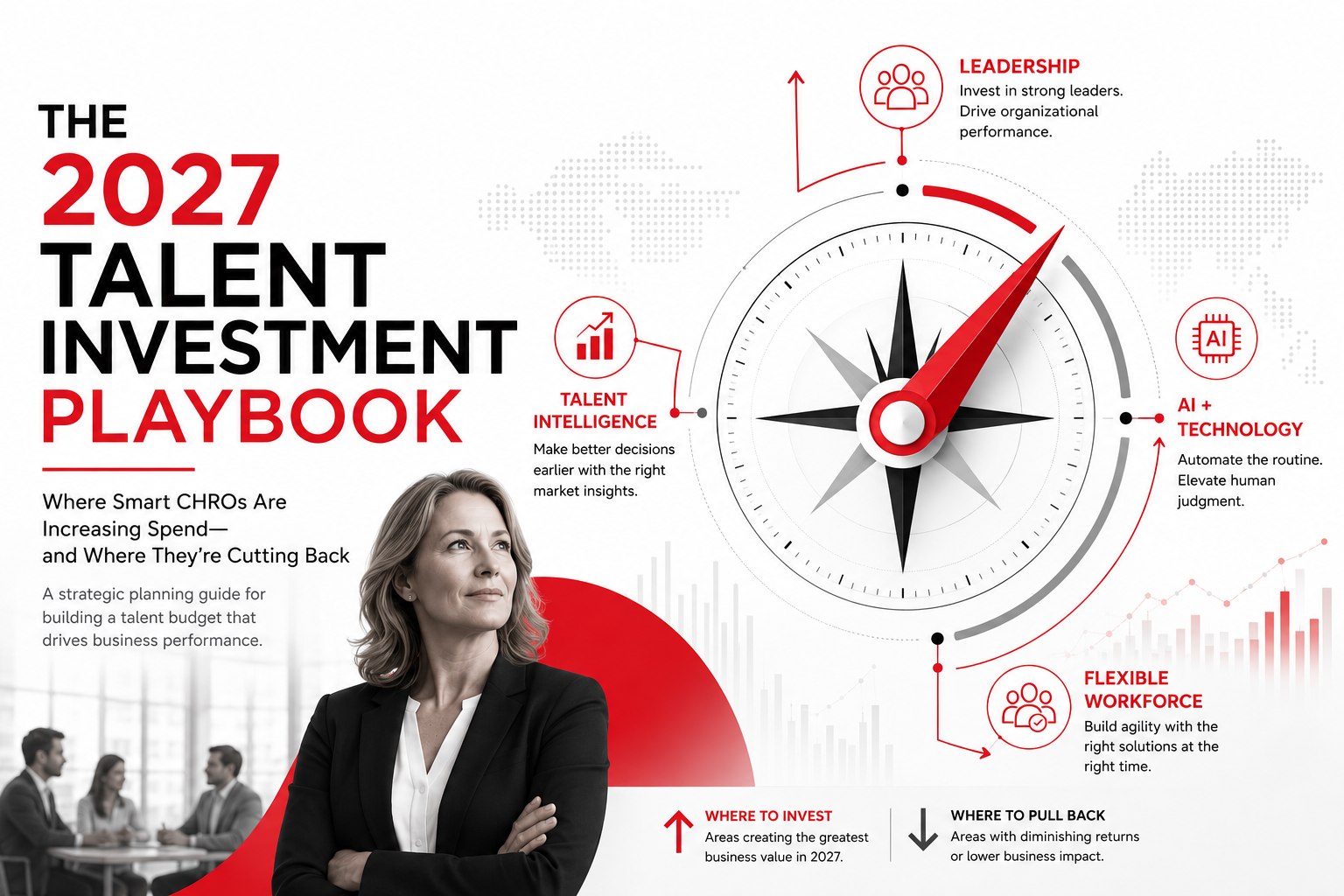

Every organization invests in talent. Some smaller percentage invest strategically.
As organizations prepare 2027 budgets, talent leaders face a very different planning environment than they did even a few years ago. Artificial intelligence is reshaping work. Critical skills remain scarce. Executive turnover continues to rise. Economic uncertainty demands greater accountability for every dollar invested.
The traditional approach to workforce planning—rolling last year's recruiting budget forward with incremental adjustments—is no longer sufficient.
Leading organizations are taking a different approach. Rather than asking, "How much should we spend?" they are asking, "Where will talent investment create the greatest business value?"
This shift represents more than a budgeting exercise. It reflects a broader transformation in how organizations view talent. Recruiting is no longer simply an operational function; it has become a strategic lever for growth, innovation, and competitive advantage.
This playbook explores the major investment trends shaping talent strategy in 2027, identifies where high-performing organizations are increasing and reducing spend, and offers practical guidance for aligning talent strategy and workforce investments with business objectives.
From Recruiting Budget to Talent Investment Strategy For decades, talent budgets were largely reactive. Organizations estimated hiring volume, allocated recruiting resources, purchased job advertising, and adjusted staffing levels as needed. Success was often measured through operational metrics such as time-to-fill, cost-per-hire, or applicant volume.
Those metrics still matter—but they no longer tell the whole story.
Today's business environment demands a broader perspective.
Organizations are expected to grow while controlling costs. They must navigate persistent labor shortages, rapidly changing skill requirements, and increasing pressure to adopt AI responsibly. Leadership teams need workforce strategies that support business outcomes—not simply hiring activity. As a result, the conversation in boardrooms is changing.
Instead of discussing recruiting budgets, executives are discussing talent investments.
This distinction matters.
Budgets focus on expenses.
Investments focus on returns.
The organizations leading their industries in 2027 are increasingly treating talent as a portfolio of investments, allocating resources toward initiatives that generate measurable value while reducing spend in areas with diminishing returns.
The following pages examine where those investments are shifting—and why.
The Talent Investment Landscape: Several forces are reshaping workforce planning for 2027.
Artificial Intelligence: AI is automating administrative recruiting tasks while increasing demand for analytical, technical, and leadership capabilities that cannot easily be replicated.
Leadership Volatility: Executive turnover remains elevated across industries, increasing the importance of succession planning and executive search.
Skills Over Roles: Organizations are hiring for capabilities rather than job titles, placing greater emphasis on adaptability, leadership, and continuous learning.
Greater Financial Scrutiny: HR leaders are increasingly expected to demonstrate measurable business outcomes from talent investments, not simply report recruiting metrics.
Together, these forces are changing how organizations allocate talent budgets.
Investment Direction: ▲ Increasing
One consistent trend across industries is a greater willingness to invest in executive and leadership hiring.
Organizations recognize that strong leadership influences every aspect of performance—from employee engagement and retention to operational execution and customer satisfaction. The cost of delaying a critical executive hire often exceeds the cost of conducting a comprehensive search. As a result, executive search is increasingly viewed not as a premium recruiting service, but as a strategic investment in organizational performance.
Executive Takeaway: High-performing organizations are protecting leadership investments even while reducing spending in other recruiting categories.
Investment Direction: ▲▲ Significant Increase
Historically, organizations gathered market information after launching a search. Leading organizations now reverse that sequence. Before approving headcount, they seek answers to strategic questions:
Is the talent available?
What is the expected compensation?
Where is the strongest labor market?
Who else is competing for this talent?
Should this role be redesigned before hiring?
This shift toward talent intelligence reduces hiring risk and improves decision quality before significant recruiting investments are made.
Executive Takeaway: The quality of hiring decisions is directly tied to the quality of information available before the search begins.
Investment Direction: ▲ Increasing
Artificial intelligence is not eliminating recruiting. It is changing where organizations invest. Routine administrative activities—including sourcing, scheduling, communication, and workflow management—continue to become more automated. This allows recruiting teams to spend more time where human judgment creates the greatest value:
executive assessment
relationship development
candidate experience
strategic workforce planning
stakeholder consultation
Organizations investing successfully in AI are reallocating human effort—not replacing it.
Executive Takeaway: The greatest return on AI comes from enabling recruiters to become strategic advisors rather than transactional administrators.
Investment Direction: ▲ Increasing
Recruiting externally will always remain important. However, leading organizations increasingly recognize that developing existing employees often produces stronger long-term returns.
Investment priorities now include:
succession planning
leadership development
internal mobility
career pathing
workforce planning
Organizations that successfully retain and develop high-performing employees reduce external hiring costs while strengthening organizational culture.
Executive Takeaway: Retention is no longer simply an HR objective—it is a financial strategy.
Investment Direction: ▲ Increasing
Rather than relying on a single recruiting model, organizations increasingly build flexible talent strategies that combine the right solutions around each business objective. Depending on business objectives, they combine:
Executive Search
Recruitment Process Outsourcing (RPO)
Project Recruiting
Staffing
Talent Intelligence
Workforce Consulting
Each solution addresses a different business challenge and plays a distinct role within a broader talent strategy. The question is no longer "Which recruiting service should we use?"
Instead:
"Which workforce strategy best supports this business objective?"
Executive Takeaway: Organizations are investing in adaptable talent strategies rather than fixed recruiting structures.
While investment is increasing in strategic areas, spending is declining in several traditional recruiting activities.
Broad Job Advertising: Mass job postings continue losing effectiveness as organizations adopt targeted sourcing and talent communities.
Manual Recruiting Administration: Automation is reducing the need for repetitive administrative recruiting tasks.
Reactive Hiring: Leading organizations increasingly develop talent pipelines before vacancies occur, reducing costly last-minute recruiting efforts.
Recruiting Measured by Activity: Applicant counts and time-to-fill remain important operational metrics, but executive teams increasingly prioritize business outcomes such as productivity, retention, leadership effectiveness, and revenue impact.
Building a Balanced Talent Investment Portfolio: Leading organizations are moving toward balanced investment portfolios that combine strategic leadership hiring, workforce planning, technology, internal development, and market intelligence.
| Investment Area | 2027 Outlook | Strategic Rationale |
| Executive Search | Increase | Leadership drives organizational performance |
| Talent Intelligence | Significant Increase | Better decisions before recruiting begins |
| AI Recruiting Technology | Increase | Greater efficiency and scalability |
| Internal Mobility | Increase | Improve retention and succession readiness |
| Leadership Development | Increase | Strengthen future leadership pipeline |
| RPO | Increase | Flexible recruiting capacity |
| General Job Advertising | Decrease | Shift toward targeted sourcing |
| Administrative Recruiting | Decrease | Automation replaces repetitive tasks |
| Reactive Hiring | Decrease | Strategic planning reduces urgency |
Insight matters. Results matter more.
EG works with organizations to translate talent strategy into execution across complex workforce environments—from manufacturing and distribution to retail, consumer-facing businesses and other organizations competing for critical talent.
Examples of that work include:
$3.5 million in savings generated through a decade-long workforce partnership focused on improving talent acquisition performance.
Long-vacant positions filled in just three weeks through a strategic talent acquisition partnership.
Seasonal hiring demands supported through full-cycle recruiting execution designed around changing business needs.
Leadership capability strengthened following an acquisition through a focused executive search strategy.
Talent selection strengthened for a national retailer through a more disciplined approach to identifying and evaluating talent.
The common thread is not a single recruiting service. It is a talent strategy built around the business challenge, supported by the right combination of intelligence, expertise and execution.
Before approving next year's talent investments, executive teams should consider:
Which talent investments most directly support our business strategy?
Where does leadership capability present the greatest business risk?
Are we investing enough in market intelligence before recruiting begins?
Which recruiting activities should be automated—and which require human expertise?
How will we measure the business impact of our talent investments?
Organizations that begin with these questions are more likely to build workforce strategies that support sustainable growth.
The organizations that outperform in 2027 will not necessarily be those with the largest recruiting budgets.
They will be the organizations making the most informed talent investments.
They will invest intentionally in leadership, intelligence, technology, workforce flexibility, and employee development while reducing spending in areas that no longer create meaningful value.
Most importantly, they will align every talent decision with broader business objectives.
For CHROs, the opportunity is significant.
Talent strategy has moved beyond recruiting.
It has become one of the most influential drivers of organizational performance.
Organizations that recognize this shift today will be better positioned to attract exceptional talent, develop stronger leaders, and create sustainable competitive advantage throughout 2027 and beyond.
Since 1958, EG has helped organizations turn talent strategy into measurable business results. Today, EG partners with employers across North America through Executive Search, Recruitment Process Outsourcing (RPO), Workforce Solutions, Workplace Solutions, and SourceSmart Talent Intelligence. Our experience spans complex, high-volume and specialized workforce environments, including manufacturing, distribution, retail and consumer-facing organizations. By combining market intelligence, recruiting expertise and flexible delivery models, EG helps leaders align talent decisions with business priorities—and execute the right solution for each workforce challenge.