Skip to content
The New Standard for Workplace Services: From Cleaning to Operational Performance
janitorial workplace services
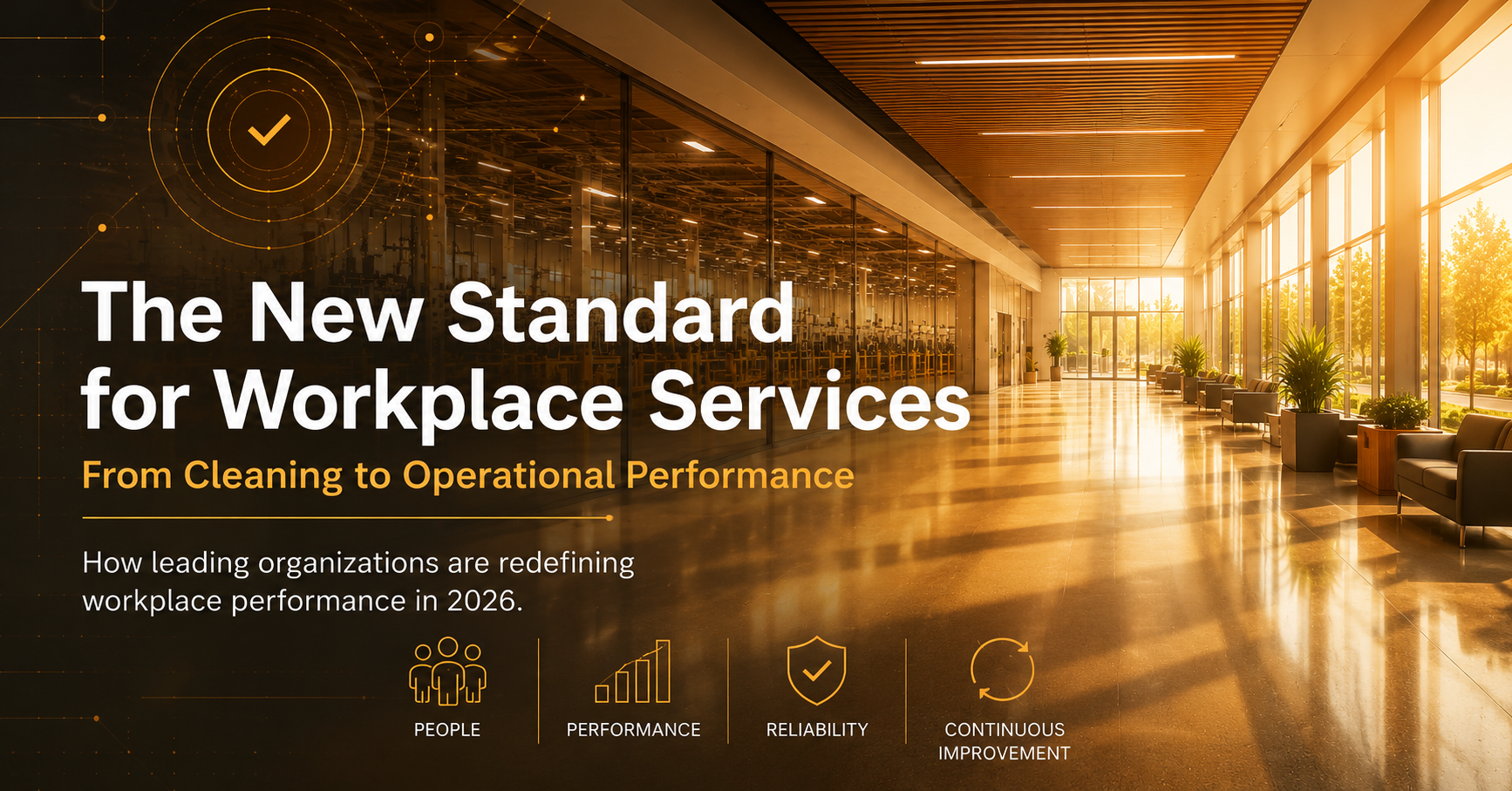
The New Standard for Workplace Services: From Cleaning to Operational Performance

EG Talent Strategist
The New Standard for Workplace Services: From Cleaning to Operational Performance
10:49


For decades, workplace services have been measured by a simple standard: cleanliness.
If the floors were maintained, the trash was removed, and complaints were minimal, the service was considered successful. The model was built around task completion, and for many organizations, that was enough.

But in today’s operating environment, that standard is no longer sufficient.

Facilities are more dynamic. Labor markets are tighter. Expectations for consistency, experience, and operational efficiency are higher than ever. And as a result, organizations are beginning to recognize a shift:

Workplace services don’t just support operations—they directly impact them.

Despite this shift, many service models remain unchanged. They are still reactive, task-based, and measured by what is completed, checked off, or visibly done rather than whether expectations are consistently met.

The Gap Between Activity and Performance

The Gap Between Activity and Performance

Most organizations evaluate workplace services based on outcomes they can immediately see:

  • Cleanliness of the environment

  • Frequency of complaints

  • Responsiveness to issues

These are important—but they are also lagging indicators.

They tell you what has already happened, not how reliably performance is being produced. This creates a false sense of stability. A facility may appear to be operating effectively, while underlying inconsistencies continue to build.

As Mike Kasten, Director of Workplace Services at EG, explains: “In many environments, the benchmark is simply ‘no complaints.’ But that doesn’t mean the operation is performing well—it means issues haven’t reached the surface yet.”

This distinction is critical. Because by the time problems become visible, the system that created them has already been underperforming.

Why Traditional Janitorial Models Fall Short

Across industries, three structural issues consistently undermine workplace service performance:

  • staffing instability

  • task-based accountability

  • reactive communication models

The challenge is not effort—it’s structure.

Most workplace services models are designed around completing tasks, not delivering outcomes. That creates variability, even when work is being done consistently on paper.

Across industries, three structural issues show up repeatedly.

Staffing Instability Creates Inconsistent Results

Turnover remains one of the most persistent challenges in workplace services. When teams are constantly changing, consistency becomes nearly impossible to maintain.

  • New team members lack familiarity with the facility 

  • Standards vary from shift to shift 

  • Accountability becomes difficult to enforce

MIke-Kasten

Over time, this leads to uneven performance that requires constant oversight.

“You can’t deliver consistent outcomes with inconsistent teams. Stability has to be built into the model.” — Mike Kasten

Task-Based Models Limit Accountability

Traditional models focus on whether tasks are completed—not whether expectations are consistently achieved or exceeded.

Two teams can complete the same checklist and produce very different results. Without clear ownership of outcomes, performance becomes subjective and reactive.

This often results in:

  • Work being completed without consistent quality

  • Limited visibility into performance trends

  • Problems being corrected, but not prevented 

Reactive Communication Slows Improvement

In many environments, communication is triggered by issues:

  • A complaint is raised

  • A correction is made

  • The process resets

What’s missing is proactive visibility—insight into performance before it breaks down.

Organizations that rely on reactive communication often spend more time managing service providers than benefiting from them.


The Hidden Cost of “Good Enough”

Because these issues develop gradually, they are often accepted as part of the model.

But over time, the cost becomes significant:

  • Increased management time spent overseeing vendors

  • Disruptions to daily operations

  • Declining employee and customer experience

  • Inconsistent brand presentation across locations

These are not always captured in traditional metrics—but they directly impact operational performance.

You can see how these challenges show up in real environments in EG’s case studies:
https://egnow.com/case-studies/
Operational-Impact

The Operational Cost of Inconsistency

One of the most overlooked impacts of workplace services inconsistency is distraction.

When workplace environments fail to meet expectations consistently, organizations absorb the cost operationally:

  • Employees become distracted by conditions around them

  • Managers spend time escalating avoidable issues

  • Teams lose focus addressing problems that should never surface 

These interruptions may appear minor in isolation, but over time they create measurable operational drag.

A poorly maintained environment affects more than appearance:

  • It impacts employee perception

  • It creates unnecessary friction

  • It pulls leadership attention away from higher-value priorities

As Mike Kasten explains: “Cleanliness should never become a recurring conversation inside an organization. The moment employees or leadership are spending time thinking about the environment, the system is already underperforming.”

The highest-performing workplace services models reduce distraction by creating consistency.

When expectations are:

  • clearly defined

  • operationalized

  • measured consistently

…teams spend less time reacting and more time focused on productive work.

That is the difference between cleaning as a task and workplace services as operational support.

A Shift in Perspective: From Cleaning to Performance

The organizations that are moving ahead are not asking, “Is the building clean?”

They are asking:

“Is our workplace services model delivering consistent, predictable operational performance?”

This shift changes how success is defined—and how services are designed.

It requires moving beyond tasks and focusing on the system that produces outcomes.

What “Good” Looks Like in 2026

The new standard for workplace services is built on five core principles. These are not incremental improvements—they represent a structural shift in how services are delivered and evaluated.
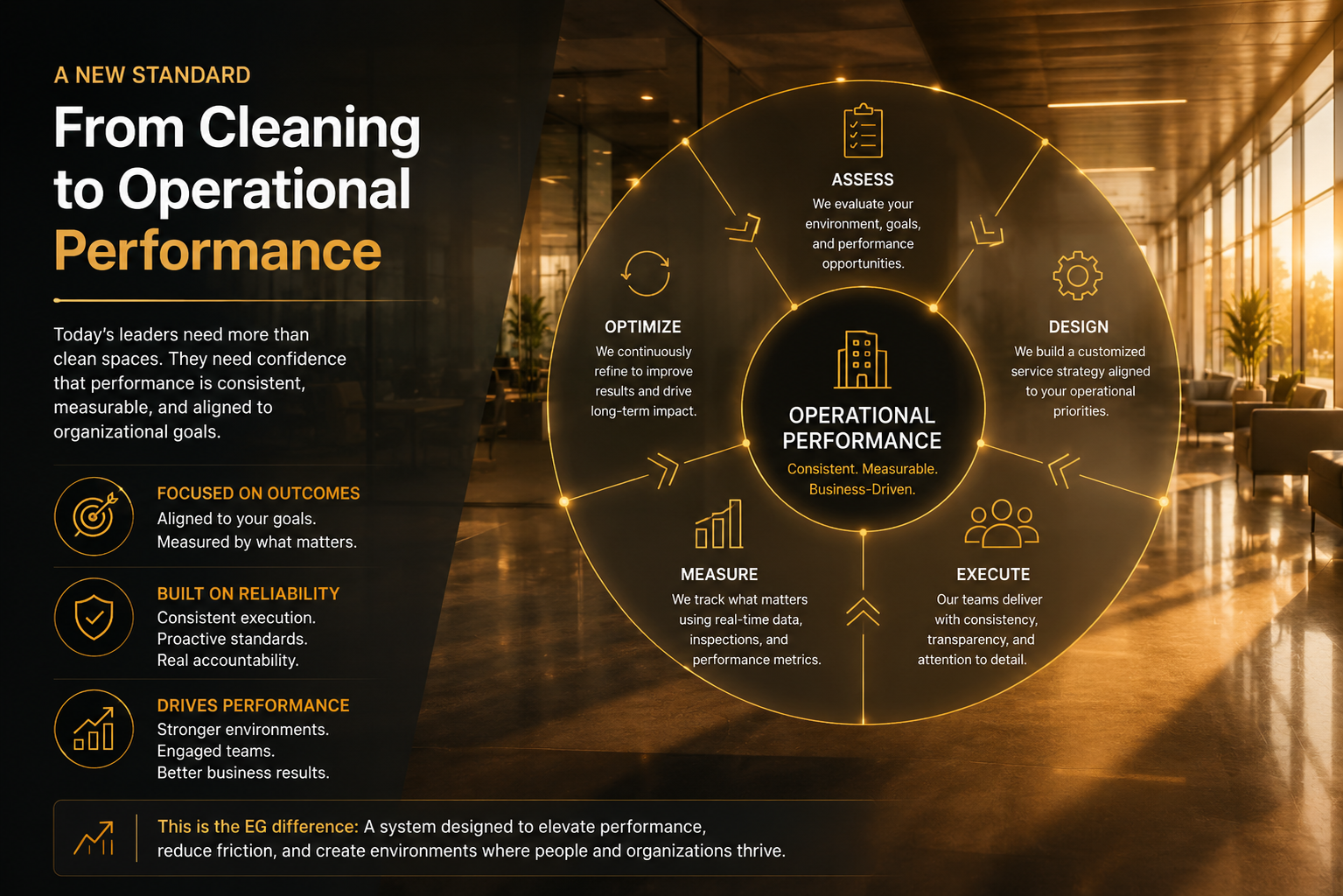
Cleaning to Performance

Consistency by Design

Consistency is not achieved through increased supervision. It is achieved through stability.

High-performing models prioritize:

  • Dedicated recruiting aligned to each account

  • Reduced turnover through better hiring and management

  • Teams that understand the specific environment they support

When staffing is consistent, performance becomes predictable.

Clear Accountability for Outcomes

Accountability must extend beyond task completion.

Organizations should be able to clearly answer:

  • Who owns the overall performance of the environment?

  • How is success measured?

  • How is consistency maintained over time?

This requires defined ownership and measurable expectations.

Proactive Communication and Visibility

Strong workplace services models provide insight—not just response.

This includes:

  • Regular performance reporting

  • Early identification of potential issues

  • Continuous feedback between provider and client

Proactive communication reduces surprises and builds trust.

For additional perspective on how EG approaches communication and operational discipline, explore: https://egnow.com/blogs/

Flexibility Without Disruption

Facilities are not static. Service models must adapt without sacrificing consistency.

This includes adjusting to:

  • Changes in facility usage

  • Production cycles

  • Seasonal demand

Flexibility is not about reacting faster—it’s about designing systems that can adapt without breaking.

Measurable Operational Performance

In 2026, performance must be quantifiable.

Organizations should track:

  • Consistency of service delivery

  • Responsiveness to issues

  • Quality assurance metrics

  • Overall satisfaction

EG clients, for example, report an average NPS of 65—well above industry norms—reflecting consistent performance over time.

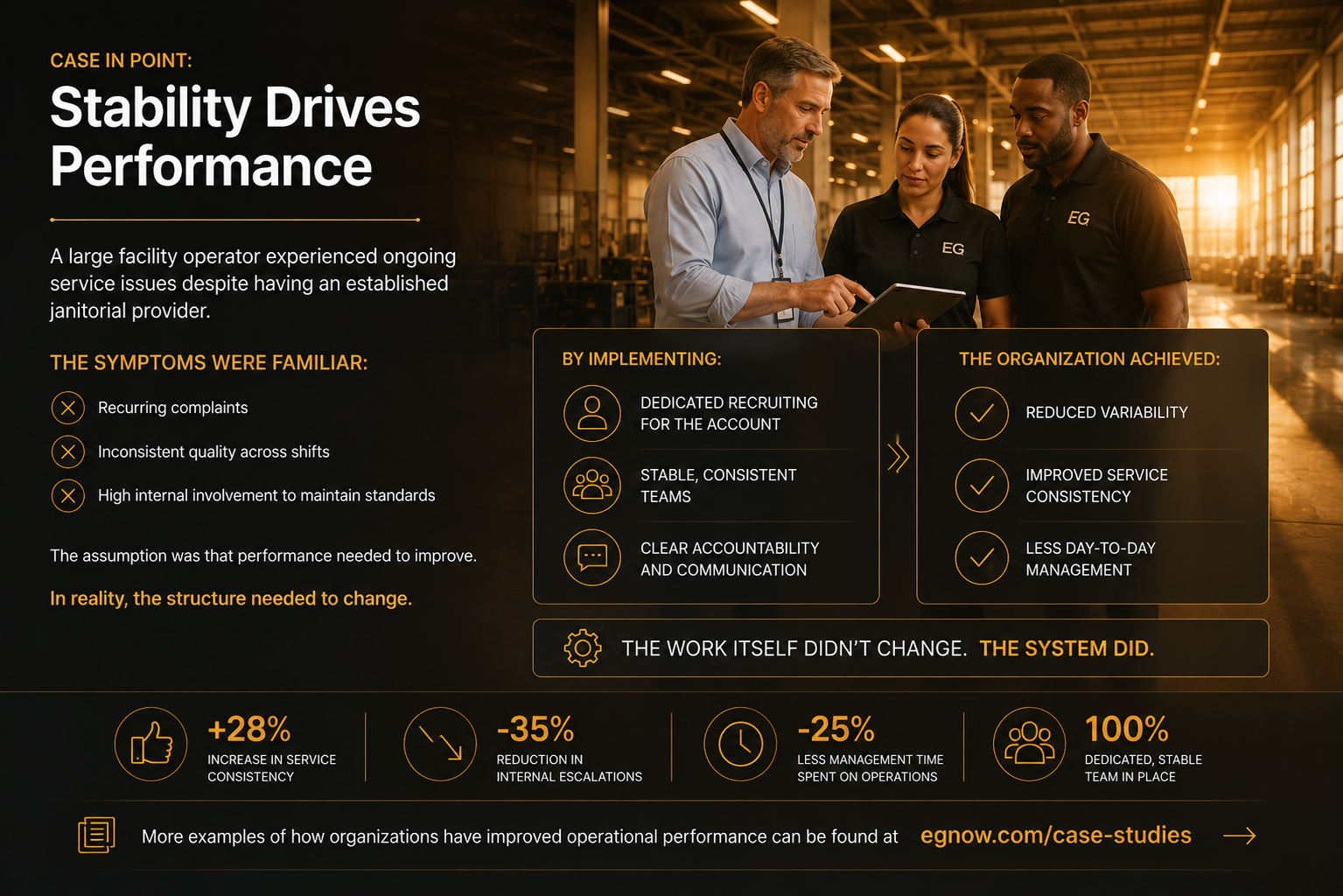
Case in Point: Stability Drives Performance

Stability Drives PerformanceA large facility operator experienced ongoing service issues despite having an established janitorial provider.

The symptoms were familiar:

  • Recurring complaints

  • Inconsistent quality across shifts

  • High internal involvement to maintain standards

The assumption was that performance needed to improve.

In reality, the structure needed to change.

By implementing:

  • Dedicated recruiting for the account

  • Stable, consistent teams

  • Clear accountability and communication

The organization achieved:

  • Reduced variability

  • Improved service consistency

  • Less day-to-day management

The work itself didn’t change. The system did.
More examples of how organizations have improved operational performance can be found here: https://egnow.com/case-studies/

The Role of Workplace Services in Business Performance

Workplace services are often viewed as a background function.

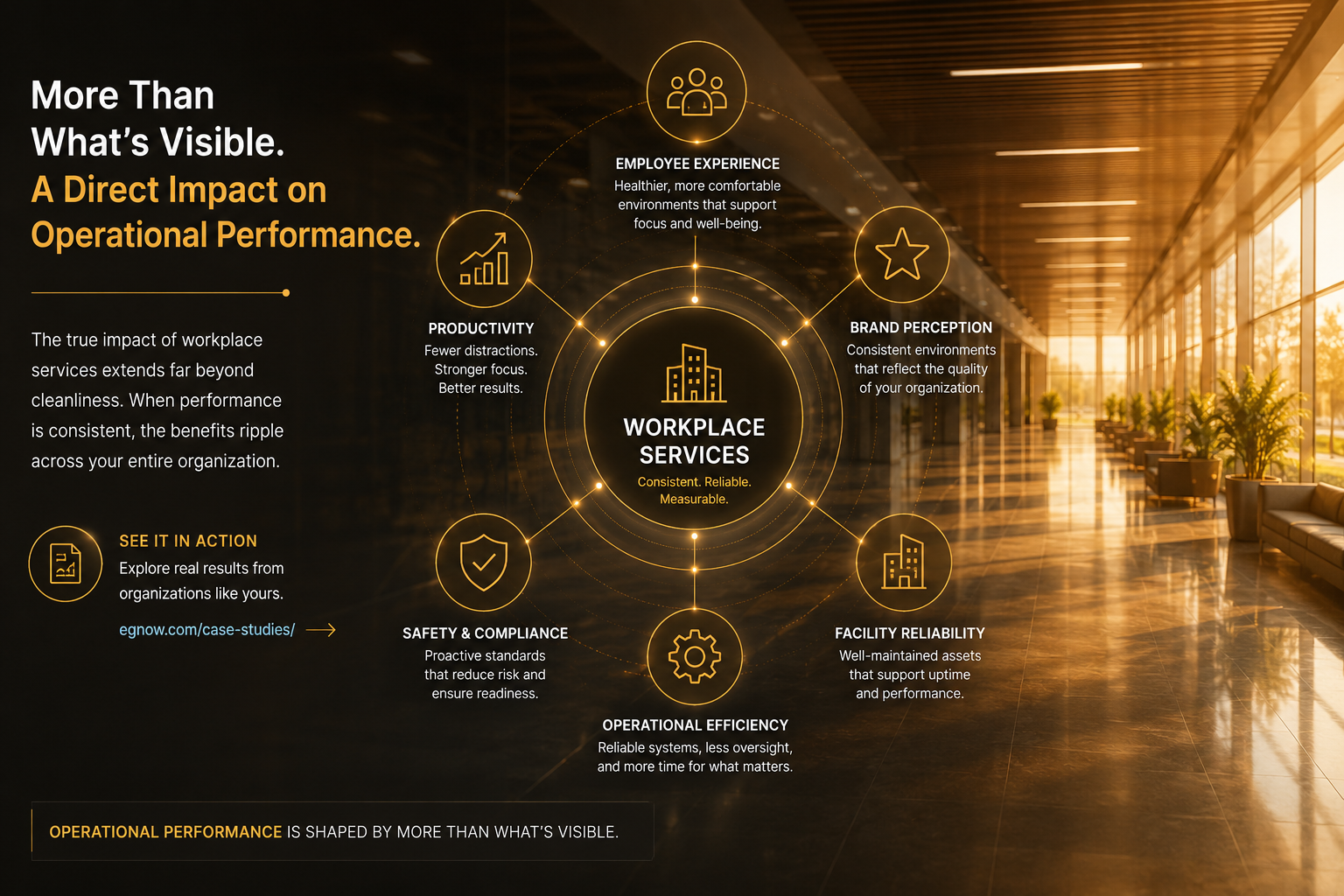
But in reality, they influence:

  • Employee experience

  • Operational efficiency

  • Brand perception

  • Facility reliability

When services are inconsistent, these areas are impacted—often without clear attribution.

When services are stable and well-designed, they create an environment where operations run smoothly and predictably.

Where EG Fits

EG Bug RGBAt EG, workplace services are built to deliver operational performance—not just completed tasks.

This approach includes:

  • Dedicated recruiting strategies to ensure consistent staffing

  • Structured operational processes that reduce variability

  • Clear accountability frameworks

  • Proactive communication and performance visibility

As Mike Kasten puts it: “We don’t manage cleaning tasks—we manage the conditions that make consistent performance possible.”

This shift—from activity to outcomes—is what defines the new standard.

Raising the Standard

The expectations for workplace services have changed.

Organizations can no longer rely on reactive, task-based models that measure success by the absence of complaints.

They need systems designed to deliver:

  • Consistency

  • Accountability

  • Visibility

  • Adaptability

Because in today’s environment:

Workplace services are not just about maintaining a facility.

They are about reducing operational friction, improving consistency, and creating environments where employees and businesses can perform at a higher level.

And the organizations that recognize that—and act on it—will create more stable, efficient, and scalable operations.

Questions Leaders Should Ask Their Current Workplace Services Provider

As workplace services evolve from a task-based function to an operational performance driver, organizations should evaluate whether their current model is built to deliver long-term consistency—not just short-term execution.

The right partner should be able to clearly explain not only what gets done, but how consistent performance is achieved, measured, and sustained over time.

Leaders evaluating their current provider should consider questions such as:

How do you reduce staffing variability across shifts and locations?

Consistency begins with stable teams. Providers should have a clear strategy for recruiting, retention, training, and account continuity—not just filling open positions.

How is performance measured proactively—not just after issues occur?

Strong operational models identify risks and inconsistencies before they become complaints.

Ask what reporting, inspections, audits, or operational visibility tools are used to maintain standards.

What operational metrics are tracked regularly?

Beyond cleanliness, providers should be able to measure:

  1. consistency of service delivery

  2. response times

  3. quality assurance performance

  4. staffing stability

  5. client satisfaction trends

If performance cannot be measured consistently, it cannot be improved consistently.

How are teams trained, retained, and aligned to our environment?

Different facilities require different operational expectations. Providers should be able to explain how teams are trained specifically for your environment—not just general cleaning procedures.

How is accountability maintained across shifts, teams, and supervisors?

Operational consistency requires clear ownership. Leaders should understand:

  • who owns performance

  • how issues are escalated

  • how expectations are reinforced daily

How does your model adapt when operational needs change?

Facilities are dynamic. Service models should flex with:

  • production schedules

  • occupancy changes

  • seasonal demands

  • operational growth

Adaptability should be built into the system—not improvised after disruption occurs.

What does success look like beyond “no complaints”?

This is often the most important question.

High-performing workplace services models should contribute to:

  • operational stability

  • reduced management burden

  • stronger employee experience

  • improved reliability across the environment

Because the goal is not simply to maintain a clean facility.

It is to create an environment where people and operations perform at their best.


Share this post