The Signal Problem: Why Leadership Hiring Fails Before the Interview Begins
At the executive level, nearly every candidate looks qualified. Resumes are strong. Experience is relevant. Track records are compelling. But those signals are often misleading. Because leadership success is not defined by what someone has done. It is defined by whether they can deliver in a specific environment.
This is what we refer to as the signal problem.
The Signal Problem
Access to executive talent has never been easier. With platforms like LinkedIn, expanded networks, and AI-powered sourcing tools, organizations can identify candidates faster than ever before. What once required deep networks and retained search can now be initiated with a few searches and messages.
But access is no longer the advantage. Evaluation is. As Erika Scanlin, President of EG, explains:
“Access used to be the advantage. Now it’s the baseline. The real challenge is knowing who will actually work in your environment.”
At the executive level, the challenge is not finding candidates. It is determining which leader will actually succeed.
Defining Signal: The CASE for Success
Signal is not experience alone. It is the combination of factors that determine whether a leader will succeed in a specific environment.
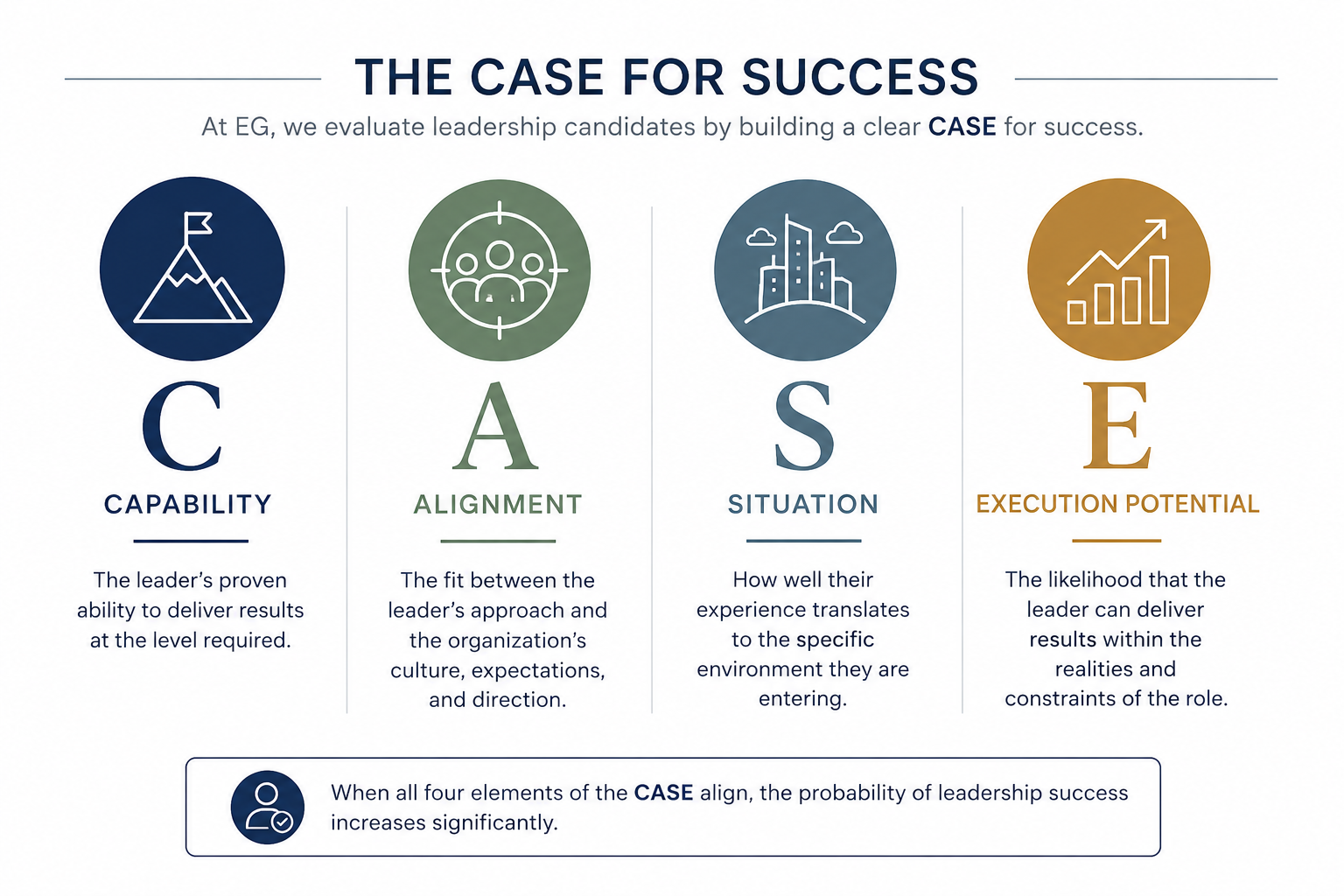
At EG, we evaluate leadership candidates by building a clear CASE for success:
-
Capability – the leader’s proven ability to deliver results at the level required
-
Alignment – the fit between the leader’s approach and the organization’s culture, expectations, and direction
-
Situation – how well their experience translates to the specific environment they are entering
-
Execution Potential – the likelihood that the leader can deliver results within the realities and constraints of the role
When one of these elements is misunderstood or missing, risk increases. When all four align, the probability of success improves significantly.
Most hiring processes, however, over-index on visible signals—titles, tenure, personality and company names—while underweighting context, alignment, and execution. As a result, organizations make decisions based on incomplete information.
And those decisions often fail—not because the candidate lacked talent, but because the full CASE for success was never properly evaluated.

Where Leadership Hiring Breaks
Leadership hiring rarely fails at the offer stage. It fails much earlier—often before the interview process has even fully run its course. There is a simple reason for this—and it starts earlier than most organizations realize. If you enter the wrong destination into a GPS, even the most efficient route will take you to the wrong place.
The directions may be accurate.
The path may be optimized.
The execution may be flawless.
But the outcome is still incorrect. Leadership hiring follows the same pattern. When a role is not clearly defined from the outset—when stakeholders are not aligned on what success actually looks like—everything that follows is built on a flawed input.
Candidates are sourced against the wrong criteria. Interviews evaluate the wrong capabilities. Decisions are made based on incomplete or misaligned expectations. By the time the process concludes, the organization has not failed to execute the search.
It has simply executed the wrong search. The issue is not how the process runs. It is how it begins.
1. Role Definition
Many leadership searches begin with a role that is not fully defined. Job descriptions are created quickly. Stakeholders align loosely. Expectations are often based on past roles rather than future needs. Key questions remain unanswered:
-
What must this leader accomplish in the first 12 to 24 months?
-
What challenges will define success or failure?
-
What type of leadership style is required for this specific environment?
-
What is the executive team around them brining to the table and how will this leader's strengths make them better collectively?
-
Where will this leader need to align with the current culture—and where will they need to challenge or evolve it?
Without clear answers, the search is built on unstable ground. Candidates are evaluated against assumptions—not outcomes—and the organization lacks a clear framework to assess the full CASE for success.
Case in Point: Growth vs Execution
A mid-market company sought to accelerate growth and hired a highly accomplished executive with a strong track record in scaling organizations. On paper, the hire made sense.
In practice, the company needed operational discipline more than strategic expansion. The result was misalignment/
The leader pushed for growth initiatives before foundational processes were in place. Execution lagged. Internal teams struggled to keep pace. Within a year, the hire was replaced. The issue was not capability. It was situational misalignment.
2. Candidate Evaluation
Once candidates enter the process, evaluation often lacks structure. Interviews vary by stakeholder. Criteria shift. Decisions rely heavily on subjective impressions. Common pitfalls include:
-
Overvaluing communication style over execution capability
-
Anchoring on past company experience without understanding the environment
- Confusing confidence with competence
Even well-run interview processes struggle with consistency. Because interviews, by nature, are limited. They provide snapshots—not full pictures. As Erika explains:
“At the executive level, everyone can interview well. The difference isn’t how they present—it’s how they perform in your specific situation.”
Without a structured lens, it becomes difficult to consistently evaluate each element of the CASE—particularly alignment and execution potential, which are rarely visible on a resume.
3. Situation Misalignment
This is the most common—and most costly—failure point. Leadership success is highly dependent on context. A candidate who excels in one environment may struggle in another.
Consider the following:
-
A transformation leader entering a stable organization
-
A corporate executive joining a founder-led business
-
A strategic thinker placed in a role requiring operational execution
In each case, the candidate may be highly capable. But capability alone does not guarantee success. Without aligning the leader to the specific needs of the organization, critical elements of the CASE—particularly situation and alignment—break down, increasing the likelihood of failure.
Why Traditional Hiring Methods Fall Short
Traditional hiring processes were not designed to solve for these challenges. They rely on tools that are inherently limited:
-
Resumes are backward-looking and often lack context
-
Interviews are subjective and inconsistent
-
References are curated and rarely predictive
These methods can help identify qualified candidates. But they are not sufficient for evaluating leadership success. At the executive level, the margin for error is too small—and the cost of failure too high.
The Cost of Getting It Wrong
When a leadership hire fails, the impact extends far beyond the role itself. Organizations often experience:
-
Strategic initiatives delayed or abandoned
-
Loss of momentum across teams
-
Decreased confidence among stakeholders
-
Cultural disruption
-
Additional time and cost to restart the search
In many cases, the financial cost is only part of the equation. The larger impact is organizational. Momentum is lost. And in competitive environments, that loss can be difficult to recover.
The Shift: From Selection to Evaluation
To improve leadership hiring outcomes, organizations must shift their approach.
From: Selecting the best candidate from a pool
To: Evaluating which candidate is most likely to succeed in a specific context
This requires a more structured, deliberate process. One that focuses on:
-
Clearly defining the role and its success criteria
-
Aligning stakeholders around expectations
-
Evaluating candidates consistently on most important criteria for your scenario
-
Assessing both capability and contextual fit
This shift enables organizations to move beyond surface-level comparison and instead evaluate the full CASE for each candidate—reducing uncertainty and improving decision quality.
Case in Point: Private Equity Portfolio Company
A private equity-backed company needed to hire a leader to drive transformation. Speed was critical. Pressure was high.
Initial candidates all had strong credentials. Many had led similar initiatives in large organizations. But deeper evaluation revealed a gap.
The role required navigating a resource-constrained environment, influencing a legacy leadership team, and delivering results quickly. Candidates with large-enterprise experience lacked that specific alignment.
By refining the evaluation criteria and focusing on contextual fit, the company identified a leader with experience in similar environments.
The result was not just a successful hire—but a faster path to execution.
A More Effective Model for Leadership Hiring
Modern executive search must evolve beyond candidate identification.
It must function as a leadership advisory process. This includes:
-
Leadership Design: Defining what the role truly requires—not just what it has been historically
-
Structured Evaluation: Applying consistent frameworks to assess candidates beyond resumes and interviews
-
Context-Based Assessment: Evaluating how candidates will operate within the specific environment
-
Integration Planning: Supporting overall team transition to ensure early traction and alignment
Deeper Insight Through Assessment
Structured interviews and resumes can help identify qualified candidates, but they often fall short when evaluating the deeper attributes that predict executive success. As Erika Scanlin explains:
"At the executive level, everyone can tell a strong story. The challenge is understanding how they actually operate—especially when the stakes are high."
To strengthen the evaluation process, EG incorporates the Socrates Assessment™ by Conchie Associates, a fully validated assessment that has demonstrated up to 84% accuracy in predicting candidate success.
Rather than measuring personality, the assessment evaluates the underlying leadership talents associated with exceptional executive performance. Drawing from Conchie Associates' research, it examines the relative strength of five leadership talent dimensions that distinguish high-performing leaders. These dimensions help organizations better understand:
-
How a leader creates direction and clarity
-
Their ability to influence and mobilize others
-
How they navigate complexity and competing priorities
-
Their capacity to drive execution and sustained performance
-
The leadership strengths they naturally bring to a team
This additional layer of insight helps organizations move beyond interviews and credentials to better understand how a leader is likely to perform within a specific environment.
For EG, these insights are particularly valuable when evaluating the Alignment and Execution Potential components of the CASE framework.
Because executive hiring is rarely about identifying the most impressive resume. It is about identifying the leader most likely to succeed in your unique context.
Leadership Hiring Is a Diagnosis Problem
Hiring an executive based solely on resume and interview performance is similar to diagnosing a complex issue based only on surface symptoms. The real drivers of success often lie deeper. Without a clear diagnosis, even the most capable leader can struggle. As Erika puts it:
“The question isn’t who’s available. It’s who will actually succeed—and that’s where most organizations get it wrong.”
Conclusion: The Decision Happens Earlier Than You Think
Leadership hiring does not fail at the end of the process. It fails at the beginning. When roles are not clearly defined. When evaluation lacks structure. When context is not fully understood.
By the time interviews are complete, the outcome is often already set. Organizations that improve leadership hiring outcomes are not those with access to more candidates. They are those with a clearer, more disciplined way to evaluate the CASE for success.
Start with Clarity
If your organization is preparing for a leadership hire, the most important work happens before candidates are selected. It begins with defining success clearly, aligning stakeholders, and building a process designed to evaluate—not just identify—leaders. Because in executive hiring, the difference is not who you find. It is who you choose—and why.